Abstract
The growing environmental concerns associated with blockchain technology have necessitated a reevaluation of consensus mechanisms, especially those based on Proof of Work (PoW). Traditional PoW consumes significant computational resources on solving arbitrary puzzles, contributing little beyond maintaining blockchain security. This paper introduces Proof of Result (PoR), an innovative consensus mechanism where participants validate the network by performing verifiable, real-world computational tasks. PoR ensures the same level of security and decentralization as PoW while repurposing computational power to address practical challenges. This approach represents a step toward a more sustainable and impactful future for blockchain technology.
Introduction
Blockchain technology has revolutionized trust and transparency in decentralized systems. From powering cryptocurrencies like Bitcoin to enabling advanced smart contract platforms, blockchains rely on consensus mechanisms to validate transactions and maintain secure, immutable ledgers. Among these mechanisms, Proof of Work (PoW) and Proof of Stake (PoS) are the most widely adopted, providing the foundation for securing networks.
Despite their effectiveness, traditional PoW systems face growing criticism due to their substantial environmental impact and inefficiencies. By design, PoW requires network nodes to perform computationally intensive operations to solve cryptographic puzzles, such as finding a nonce that meets predefined criteria. While this approach ensures robust security, it consumes enormous amounts of electricity and hardware resources, contributing nothing of practical value beyond securing the blockchain.
The Problem
- Environmental Concerns
The energy consumption of PoW-based blockchains has escalated to levels comparable to those of small nations. This immense energy demand contributes to climate change and raises ethical questions about the sustainability of such systems in the face of global environmental challenges. - Resource Wastage
PoW computations generate no value beyond achieving network consensus. Billions of computational operations are discarded after the successful mining of a block, providing no tangible benefits to society or industry, which underscores the inefficiency of this model. - Scalability Challenges
As PoW tasks become increasingly complex, resource competition intensifies, effectively limiting participation to entities with substantial computational power. This trend undermines the decentralization ideal of blockchain by centralizing control in the hands of a few dominant players, threatening the integrity and inclusivity of the ecosystem.
The Vision: Moving Toward Useful Work
The Proof of Result (PoR) offers a compelling alternative. Instead of expending resources on arbitrary tasks, PoR leverages blockchain consensus to solve practical and verifiable computational problems with real-world applications. These tasks, sourced from a decentralized pool, can span diverse fields such as scientific research, engineering, artificial intelligence, and public goods computation.
By redirecting computational power toward meaningful outcomes, PoR transforms blockchain networks into engines of innovation and sustainability. This approach maintains the security and decentralization benefits of PoW while addressing its inefficiencies and environmental shortcomings.
Core Goals of Proof of Result
- Sustainability:
Reduce the carbon footprint of blockchain technology by ensuring that every computation contributes to solving a valuable problem. - Practical Utility:
Turn blockchain nodes into decentralized computational resources, solving problems that benefit industries, research communities, and society. - Equitable Participation:
Enable a broader range of participants by categorizing tasks by difficulty and allowing nodes with varied computational capabilities to contribute. - Security and Trust:
Preserve the robust security model of PoW by integrating cryptographic validation and decentralized consensus mechanisms into the task execution and verification process.
How Proof of Result Operates
Proof of Result (PoR) is a blockchain consensus mechanism designed to integrate practical and valuable computations into the process of validating transactions and securing the blockchain. It preserves decentralization and security while maximizing the utility of computational resources. Below is a detailed explanation of how PoR operates.
1. Task Pool: Sourcing Practical Problems
At the core of PoR is a decentralized task pool, which stores computational problems submitted by individuals, organizations, or automated systems. Tasks can include problems from various domains, such as:
- Training artificial intelligence models.
- Simulating physical phenomena (e.g., protein folding or climate modelling).
- Performing complex engineering calculations.
Each task in the pool includes metadata such as:
- Task ID: A unique identifier. It can be a hash of the task
- Difficulty Level: To match tasks with nodes computational capacities.
- Maximum Price: The highest reward the task owner is willing to pay for its completion.
- Computational cost: The price for the unit of spent computational resources (higher value prioritize the task)
- Estimated Resources: CPU, GPU, or memory requirements.
While this document does not delve into the intricacies of task management, tasks are generally prepared and submitted using approaches such as container-based systems. These systems provide OS-level virtualization, bundling libraries, system tools, code, and runtime into a unified package.
Large tasks are constrained by the Maximum Price and must be divided into smaller, manageable subtasks before submission. This ensures that even resource-intensive problems can be distributed across the network for efficient execution.
2. Task Selection by Nodes
In the PoR network, the nodes responsible for executing tasks are referred to as Solvers. Each Solver autonomously selects tasks from the decentralized task pool based on its computational capabilities and available resources. This approach ensures efficient task allocation and promotes equitable participation across the network.
Key aspects of task selection include:
- High-Capability Nodes: Nodes with advanced hardware and greater computational power prioritize more complex tasks. These tasks often offer higher rewards, incentivizing Solvers to utilize their capabilities fully.
- Low-Capability Nodes: Nodes with limited resources focus on simpler tasks. This ensures that nodes with modest computational power can still contribute meaningfully, promoting inclusivity and reducing the risk of centralization.
By enabling Solvers to select tasks suited to their hardware and resource profiles, PoR creates a balanced and accessible ecosystem where nodes of all sizes can participate and earn rewards proportionate to their contributions.
3. Computation and Solution Submission
When a Solver selects a task, it begins executing the required computation and tracks the computational resources expended on the task, referred to as Resource. Upon completing the computation, the Solver produces a solution and submits it, along with key metadata, to the network for validation and potential inclusion in the blockchain.
The solution submission process involves the Solver cryptographically signing the solution and broadcasting it to the network. Alongside the solution, the Solver includes:
- Resource, detailing the computational power consumed during the task.
- Claimed Reward, which is calculated as the product of the Resource value and the Computational Cost specified in the task’s metadata.
The Claimed Reward cannot exceed the task’s Maximum Price defined in its metadata. If the computation consumes resources equivalent to the Maximum Price but the solution is incomplete, the Solver is still entitled to claim the Maximum Price as compensation for its efforts.
To ensure transparency and security, the submitted solution is represented by its hash, allowing other network participants to verify it without revealing the full details. The Resource value provides a measure for evaluating the computational effort involved, while cryptographic signatures bind the solution to the Solver, ensuring traceability and preventing tampering.
4. Verification by Other Nodes
To ensure result validity, Verifiers within the network randomly select completed tasks recorded on the blockchain from a certain number of past blocks. The verification process involves the following steps:
- Recomputing the Solution
Verifiers independently execute the selected task and generate their own solution, along with the resources spent during computation. This solution is broadcasted to the network and included in the blockchain for transparency. - Matching Hashes and Resources
Network nodes compare the solutions provided by the Solvers and the Verifiers. They also evaluate the resources spent as reported by both parties. The results must match within an acceptable tolerance level. - Consensus
If there is a mismatch between the Solver’s and Verifier’s solutions or the reported resource usage, a Collision is triggered, prompting further investigation or penalties.
Verifiers are not dedicated nodes but rather nodes that periodically assume the verification role. For instance, after solving 10 tasks, a node may be required to verify one task. This ratio can be dynamically adjusted based on the collision rate or other network parameters.
Tasks are randomly selected by Verifiers, and in some cases, multiple Verifiers may verify the same task. This redundancy mitigates the risk of sabotage, such as a Verifier colluding with the Solver by submitting identical results. For this system to work effectively, a baseline assumption is that there is a sufficient number of honest Verifiers in the network.
The Verifier role does not come with direct rewards. Instead, it is treated as a duty necessary for maintaining the network’s integrity. Nodes cannot opt out of this role, as their participation is tracked and validated through a Result score. This score reflects a node’s contribution to solving and verifying tasks and ensures compliance.
5. Collision Handling
In case the nodes recognise the collision, they temporarily switch to traditional Proof of Work (PoW) to resolve the conflict:
- Collision Detection:
Nodes detect a Collision when there is a mismatch between Solver and Verifier. - Solution finding:
All nodes participating in conflict resolution independently execute the task, which resulted in this collision - Consensus Through Mining:
After solution is found, nodes enter a light PoW phase where they solve a cryptographic puzzle. The first node to find a valid nonce is allowed to include their solution in the blockchain. See more details below. - Validation of Majority:
Once the chain includes several consecutive PoW blocks, the conflict is considered resolved. - Penalties for Fraud:
Nodes submitting invalid solutions (either solver or verifier) are penalized by losing of their Result score and part of their deposited coins.
6. Result score
The Result is a fundamental parameter that defines the performance and reliability of a node in the Proof of Result (PoR) network. It depends on the cumulative resources spent by the node as well as any penalties applied for improper behavior. Similar to the stake in a Proof-of-Stake (PoS) blockchain, a higher Result score increases the likelihood of a node being chosen to propose a new block. Unlike PoS, however, the Result score grows dynamically over time for honest nodes, reflecting their contributions to solving and verifying tasks.
This design eliminates the need for nodes to hold a significant stake or upfront capital to join the network. Instead, anyone with computational resources, such as a CPU or GPU, can participate and begin earning rewards. This approach lowers the barriers to entry and fosters decentralization, allowing a more diverse range of entities to contribute. To ensure network security and prevent repeated attacks that might force the system into a Proof-of-Work-like state, every participant is required to deposit a small number of coins upon joining the network. These coins act as collateral and are deducted in cases of fraudulent behavior.
The Result is not a simple scalar value but rather a multidimensional vector containing additional information, such as the number of tasks solved and verified by the node. This detailed structure allows the network to verify that each node is fulfilling its expected roles, ensuring fair distribution of responsibilities and maintaining trust in the system.
7. Block Formation
Once solution is published, nodes include it in a new block along with transaction data and metadata:
Data Content (Record):
- Solved tasks: {task_id, hash of solution, Resource, Claimed Reward}.
- Verified tasks: {task_id, hash of solution, Resource}.
- Transaction data incl. rewards for the tasks to Solver
- Updated Results of the Solvers and Verifiers
- Total_Result (the sum of Results of all network participants)
The reward allocation mechanism ensures that the task-solving node receives the designated reward. This reward is assigned in the transaction field by the block publisher after validating that the claimed reward meets predefined criteria, such as not exceeding the maximum allowable price. Verifiers, however, do not receive direct rewards for their role, as their contribution is considered a duty to maintain network integrity.
In the blockchain’s default operational mode, where no conflicts occur, the block formation process operates using a mechanism analogous to Proof-of-Stake (PoS). However, in this system, the stake is replaced by the Result score. The newly formed block is then broadcast to the network for validation and inclusion in the blockchain.
8. Hybrid Operation Mode
Proof-of-Result actually combines and relies on two well-known and proven blockchain mechanisms:
- PoS Regime: This is one of a classical Proof-of-Stake where “Stake” value is replaced with Result . Focuses on computationally efficient block creation by comparing hashes of data records and miner identifiers. This mode is used during default operation to ensure the blockchain progresses efficiently. Computational resources in this regime are mostly spending for usefull tasks.
- PoW Regime: Traditional Proof-of-Work is used to resolve conflicts, validate branches, and merge forks into a single consistent chain when necessary.
In scenarios where the task pool is empty or the network faces persistent conflicts, PoR can seamlessly transitions into traditional PoW. This property greatly increase the security of PoR blockchain, nearing it to the bullet proof PoW.
9. Ecosystem Token
The PoR ecosystem operates using a native cryptocurrency known as Utili Coin. This coin serves as the fundamental medium for all economic transactions within the network. Task execution rewards, penalties for improper behavior, and network joining deposits are all processed exclusively using Utili Coin. These transactions are securely recorded and managed through the blockchain using the PoR consensus mechanism, ensuring transparency, accountability, and decentralized operation
Integration PoS and PoW Regimes Into Unified PoR System
The design of the Proof of Result (PoR) system incorporates both Proof of Stake (PoS) and Proof of Work (PoW) mechanisms, allowing seamless switching between the two modes. This hybrid approach ensures efficient operation under normal conditions while providing robust resolution during conflicts. Below is an outline of the dual-mode operation:
1. PoS Regime
In the PoS regime, blocks are generated based on data records selected from the memory pool in chronological order. The process involves computing a hash of the selected data: h(data). Nodes then concatenate this hash with their public key, the hash of the previous block, and a small integer n:
S = hash_prev_block || public key || hx || n
A second hash is computed on S, and the resulting value h(S) is compared against a target value proportional to the node’s Result score relative to the network’s Total_Result. If the resulting hash value h(S) is below the target which is proportional to Result value, the node is allowed to publish the block: h(S) < f(Result/Total_Result)
Nodes can try different h(data) values, corresponding to various data records in the memory pool, and adjust n within a predefined range 0…N. The variable n enhances flexibility and efficiency in block generation, and the parameter N can be dynamically adjusted based on the rate of incoming data and the number of participating nodes.
2. PoW Regime
When conflicts arise, such as block collisions or extended forks, the system transitions into the PoW regime to resolve disputes. In this mode, nodes employ the traditional Proof of Work mechanism, solving a cryptographic puzzle to find a nonce value that satisfies a predetermined hash condition. This nonce value is included in the PoW block structure. The PoW regime effectively resolves conflicts, collapsing competing branches into a single chain and restoring network consensus.
3. Blockchain Structure
The structure of each block in the PoR blockchain is as follows:
– Previous Block Hash
– Timestamp
– Difficulty Level
– Nonce (for PoS regime number n)
– PoS/PoW (how the block is formed)
-Data Content
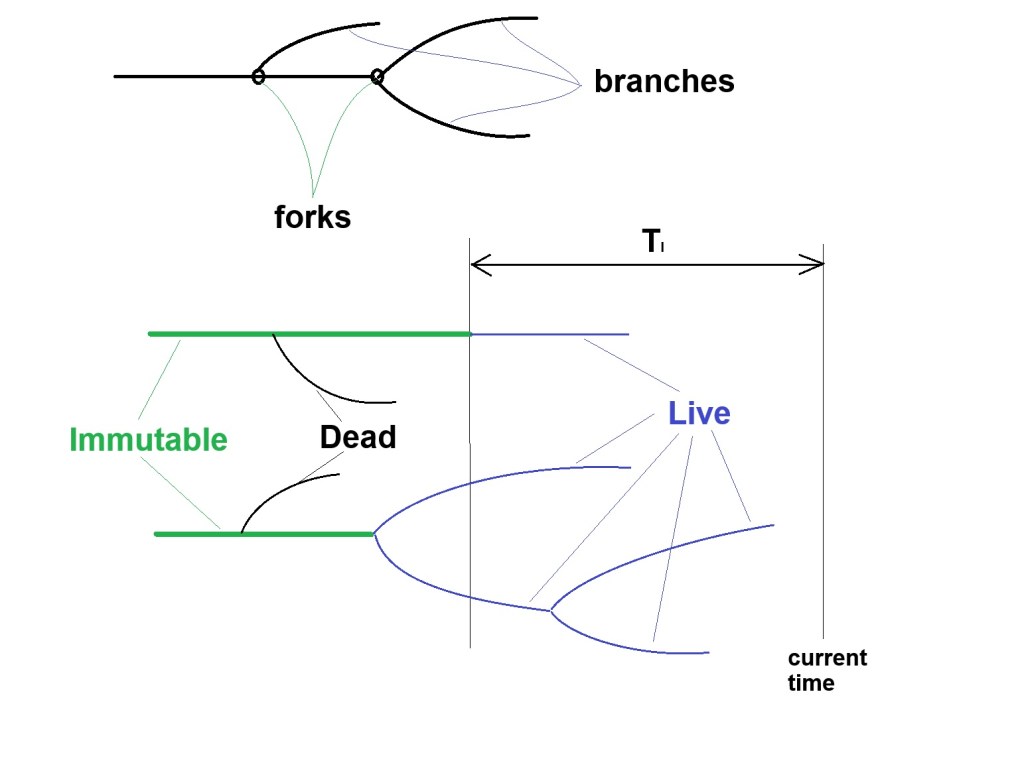
4. Immutable, Live and Dead Branches
In the blockchain, multiple branches may temporarily coexist due to forks. These branches are categorized based on their status and time of existence as follows:
Immutable Branches
Immutable branches consist of blocks that belong to the finalized part of the blockchain. These blocks are located in the past, prior to a defined time threshold TI, and are not associated with any active forks. Once blocks become immutable, they are permanently recorded in the blockchain, ensuring that their state cannot be altered.
Dead Branches
Dead branches are those that were part of temporary forks but have been abandoned and ended in the past before the time threshold TI . These branches no longer contribute to the active state of the blockchain and are considered invalid. As a result, blocks from dead branches are removed from disk storage to conserve resources, ensuring that only the relevant blockchain data is retained.
Live Branches
Live branches are active forks that extend beyond the time threshold TI or exist entirely after TI. These branches remain mutable and can continue to grow as new blocks are appended. Live branches are subject to ongoing validation and consensus processes, such as PoS or PoW, to determine which branch will ultimately be accepted as part of the main immutable chain. While still under consideration, blocks of all live branches are temporarily stored to support this decision-making process.
The diagram illustrates the definitions introduced:
Rules for Managing Live Branches
- Validation:
Nodes validate data in live branches to ensure consistency with memory pool entries, compliance with timestamp tolerances, and adherence to block publishing rules. Honest nodes do not continue branches containing invalid blocks
- Preference for the Longest Valid Branch:
Miners prioritize extending the longest valid branch unless a PoW branch (containing PoW blocks) is present. In cases where multiple branches have the same length, the branch with the smallest h(S) value in its last block is given priority.
- Priority for PoW Branches:
Valid PoW branches (containing PoW blocks) take precedence over other branches, even if they are shorter. This ensures that conflicts and forks are resolved effectively using the robust PoW mechanism.
- PoW Transition Rule:
The network transitions to the PoW regime under specific conditions. If multiple live branches exceed a maximum length Tmax(Tmax < TI) or if a Collision is detected, PoW is activated. During this state, nodes must generate a fixed number of successive PoW blocks. As soon as one live branch exceeding Tmax is left the network switches back to PoS. In case of PoW trigged due to Collision, a fixed number of successive PoW blocks must be generated.
- Penalties for Invalid Solutions:
Nodes that provide incorrect solutions are penalized with a fixed coin deduction. These penalties are redistributed to the nodes which generate valid PoW blocks. This mechanism discourages dishonest behavior while incentivizing conflict resolution.
Details
While this introductory paper provides a high-level overview of the PoR blockchain, many operational details remain beyond the scope of this discussion. Some of these key aspects include:
- The decentralized task pool, covering how tasks are submitted, managed, and distributed.
- Dynamic task allocation mechanisms to ensure efficient distribution and prevent multiple nodes from sourcing the same task simultaneously.
- The communication protocol governing interactions between task issuers and solvers.
- The balance between Solvers and Verifiers, ensuring an optimal ratio for network stability and efficiency.
- Adaptive block creation criteria, dynamically adjusted based on the number of participating nodes to maintain performance and scalability.
- And much more.
These aspects are critical to the functionality and scalability of the PoR ecosystem and will be addressed in future technical documentation.
Call to Action
Proof of Result (PoR) represents a significant paradigm shift in blockchain technology, moving beyond the traditional limitations of Proof of Work (PoW). By aligning computational power with meaningful, real-world tasks, PoR addresses pressing environmental concerns while unlocking new opportunities for industries, researchers, and communities worldwide.
This innovative approach prioritizes sustainability, utility, and meaningful contributions, making blockchain technology more relevant and impactful. However, the successful implementation and adoption of PoR will require collaboration, investment, and a shared commitment to advancing this vision for the future of blockchain technology.
We invite you to join us on this transformative journey. Whether you are an investor, industry leader, researcher, developer, or simply curious about the possibilities of PoR, your involvement is crucial in shaping its success.
For inquiries, partnerships, or to learn more about Proof of Result, please contact us at:
Email: utilichain@gmail.com
Together, we can redefine the future of blockchain technology.

 UtiliChain
Leave a comment